Captain Ratatype
Typing speed levels: from beginner to legend
We divided all participants into seven levels based on their typing speed in words per minute (WPM).
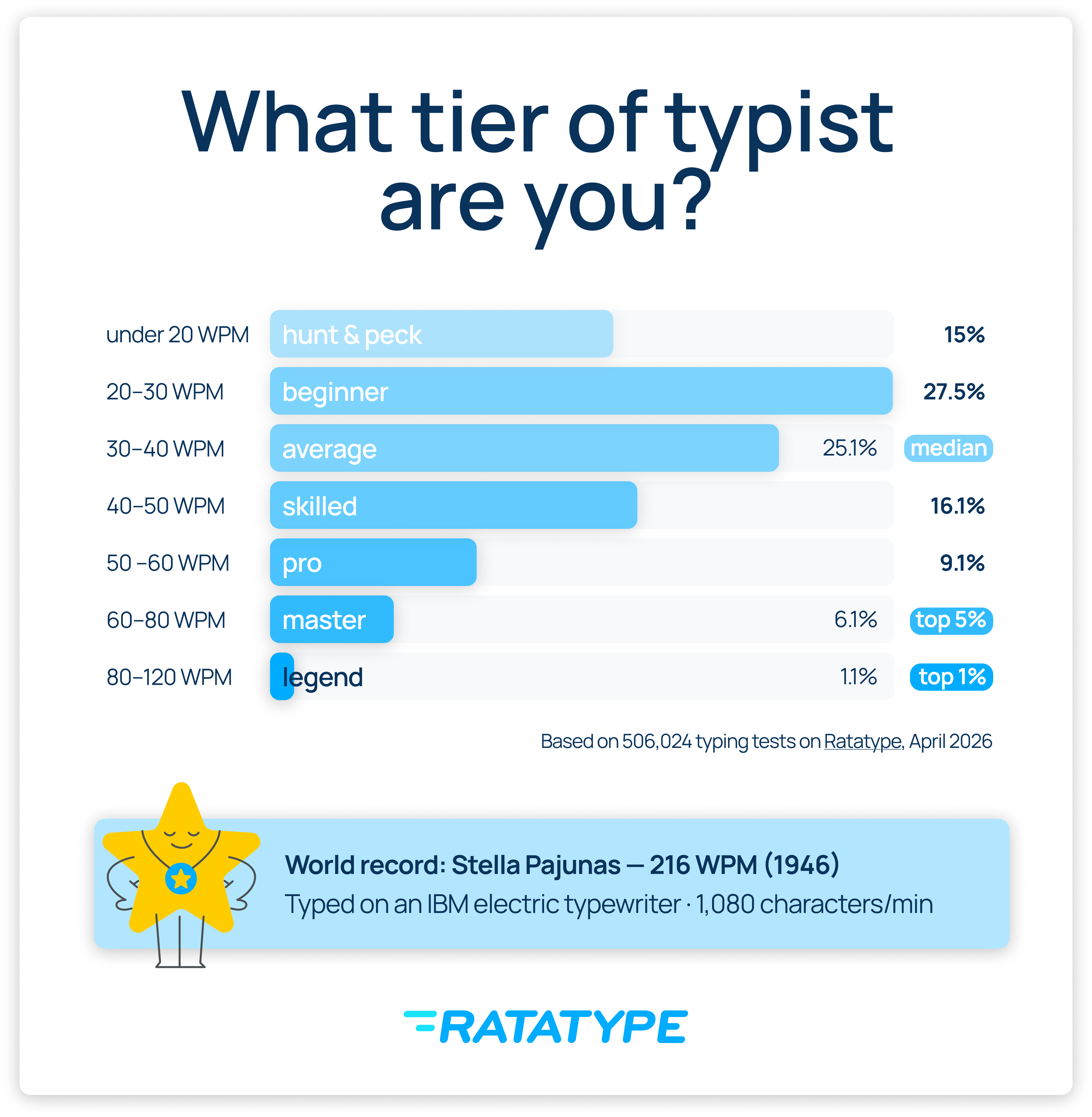
Hunt & Peck: under 20 WPM (15% of people)
"Hunt and peck" is the name for the two-finger typing style where a person searches for each key with their eyes. That's how one in seven users types. It's slow, but perfectly functional for everyday tasks.
Beginner: 20–30 WPM (27.5%)
The largest group. Almost a third of everyone who took the test falls here. The person already knows their way around the keyboard but hasn't developed a steady rhythm yet. For handling large volumes of text — it's not enough.
Average: 30–40 WPM (25.1%) — median
This is the median — right in the middle. Half of people type slower, half type faster. For most office tasks this is sufficient, but productivity still leaves room for improvement.
Skilled: 40–50 WPM (16.1%)
This is where real comfort begins. The person thinks about the text, not the keys. It's a good level for most computer-related professions.
Pro: 50–60 WPM (9.1%)
Only one in eleven people reaches this level. These typists are noticeably faster than their colleagues, experience less fatigue from typing, and get significantly more done during a workday.
Master: 60–80 WPM (6.1%) — top 5%
Getting here means joining the top five percent of the world's fastest typists. This result is typical of experienced programmers, journalists, and translators — people for whom the keyboard is their primary work tool.
Legend: 80–120 WPM (1.1%) — top 1%
One percent. These are people who don't need to think about the typing process at all — their fingers move on their own. If you're here — you're a true exception.
So what is the average typing speed?
According to our test data, the median falls in the range of 30–40 WPM. So "normal" is roughly 35 words per minute.
For comparison: the average person speaks at around 130 words per minute. That means we think three times faster than we type. This gap is where a huge potential for productivity gains is hiding.
If you increase your typing speed from 35 to 60 WPM, and you spend 4 hours a day at the keyboard, you'll save nearly 1.5 hours every day. That's over 30 working days a year.
World record: 216 WPM in 1946
The fastest typist in history is Stella Pajunas. In 1946, she typed at a speed of 216 WPM on an IBM electric typewriter — 1,080 characters per minute, or roughly 18 characters per second.
For comparison: if the median Ratatype user types one word in 1.7 seconds, Stella did it in under 0.3 seconds.
The record has stood for nearly 80 years — and has never been broken in the category of classical typewriting.
How to improve your typing speed?
The good news: typing speed is a skill you can train. Unlike, say, musical pitch, there's no innate talent required here — just practice.
A few principles that actually work:
- Learn touch typing. If you're still looking at the keys — that's the first thing to change. Touch typing frees up your attention and significantly speeds up your rhythm.
- Practice regularly, not for long. 15 minutes a day beats two hours once a week. Muscle memory is built through repetition, not duration.
- Accuracy first, then speed. Trying to type fast while making errors is two steps forward and one step back. Focus on accuracy — speed will follow.
- Track your progress. Without regular tests it's hard to see improvement and stay motivated.
Take the free test on Ratatype — find out your level and start training to improve your result!